

In the News


Winter Forum 2019: All Systems Go!
This Winter Forum put students in the center of solving global energy poverty with support from the Energy Access Project. Students were asked to take the lead in creating a masterplan for rural electrification for the imaginary country of Wodala. Teams had to negotiate competing stakeholder interests, consider country-specific context, and build a plan that would appeal to a panel of international financiers!

New Faculty Director, Policy Associate
The Energy Access Project is delighted to announce two new additions to the team! Marc Jeuland, Associate Professor of Public Policy and Global Health, has been appointed Faculty Director, and new hire Victoria Plutshack has joined us as a Policy Associate.

New Project – Benin’s Off Grid Energy Access Project
Researchers from Duke University have begun working with the U.S. Millennium Challenge Corporation and Social Impact to evaluate Benin’s new Off Grid Energy Access Project.

Remembering Jim Rogers
Duke University, and the Energy Access Project, lost a valued friend, adviser, and visionary with the passing of James E. “Jim” Rogers on Mon., Dec. 17, 2018.

Energy in Emerging Markets Case Competition
Congratulations to 2019 Energy in Emerging Markets Case Competition winners! On Nov. 5, a dozen student teams from across the United States and overseas came to Duke University for the finals of the Energy in Emerging Markets Case Competition to pitch solutions to Aspire Power Solutions, a startup company deploying hybrid solar systems in Lagos, Nigeria’s largest city, to try to make electricity more reliable, affordable, and cleaner for businesses and residents.

Duke student organization publishes new case studies on sustainable energy and technology
What do dusty solar panels, biomass cookstoves, biogas-fueled sanitation systems, and renewable project finance have in common? Each is featured in a new volume of energy access case studies from Duke student authors. It’s the second volume of case studies published by Duke University’s Global Energy Access Network (GLEAN), a student organization. GLEAN brings together graduate, professional, and undergraduate students across disciplines, affording opportunities to explore diverse perspectives on energy access issues and discuss relevant fieldwork experiences.

Duke Students Create Energy Datasets and Tools with Wide-Ranging Impact Through Data+ Summer Research
Nearly a third of humanity lacks reliable electricity. Over the summer as part of Duke University’s Data+ program, Duke student teams deployed cutting-edge data analysis techniques to aid the search for solutions to this global challenge. Guided by Duke faculty, students learn how to marshal, analyze, and visualize data, while gaining broad exposure to the modern world of data science. Both teams’ research efforts contribute to the goals of Duke’s Energy Access Project, a new research and policy effort that aims to address the challenges around increasing access to modern energy solutions to underserved populations around the world. Key Duke collaborators in this effort include the Nicholas Institute for Environmental Policy Solutions, the Duke University Energy Initiative, the Sanford School of Public Policy, Bass Connections, and the Nicholas School of the Environment.
Meeting the Energy Needs of the World
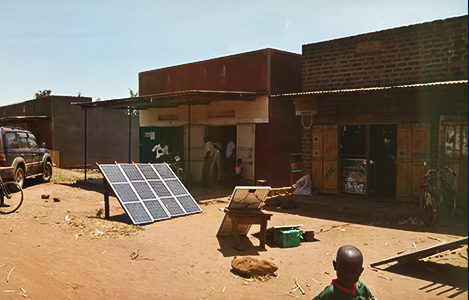
Access to modern and reliable energy is something that most of the world takes for granted. But many around the world are living a different reality. Across sub-Saharan Africa and India, children often complete homework by the flicker of candles and kerosene lamps as wisps of smoke trickle up around them from the stoking of the fire beneath their cooking stove. The Duke University Energy Access Project aims to help achieve the United Nation’s (U.N.) seventh Sustainable Development Goal, which is to ensure universal access to affordable, reliable, and modern energy services by 2030.

Household Solar Adoption in Low- and Middle-Income Countries: A Systematic Review
Hannah Girardeau and Subhrendu Pattanayak have published an EfD Initiative paper on the enabling environment of offgrid solar. They identified 42 studies in 26 countries that describe the enabling environment: the constellation of financial, market, programmatic, and regulatory factors that lead to adoption of small-scale solar systems. At the household level, the cost of technology and quality of a product have the potential to greatly impact the success of a program. On a programmatic scale, customer support and ongoing maintenance have the potential to increase sustainable use of products. Finally, supportive government level policies and design standards can encourage the growth of high-quality products in regional markets.