

In the News

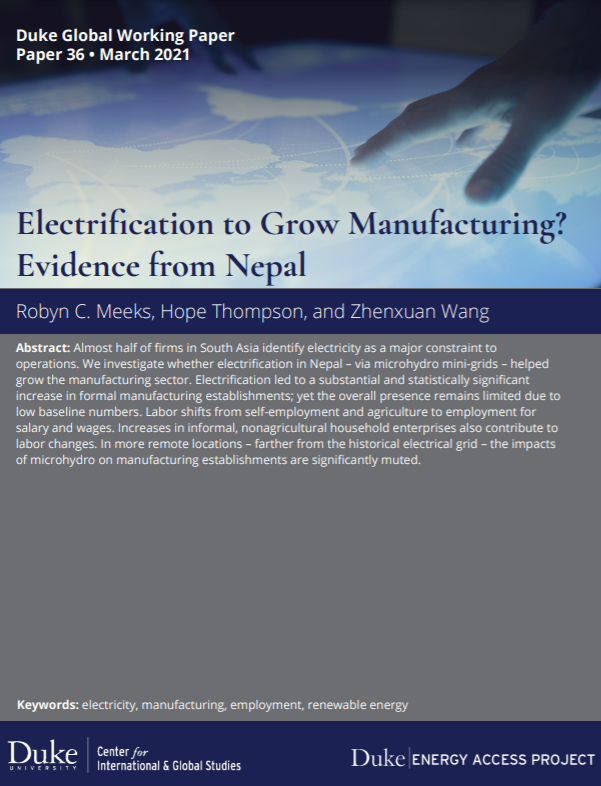
New Working Paper: Electrification to Grow Manufacturing? Evidence from Nepal
In the inaugural working paper of our new series, Robyn Meeks and co-authors explore the impacts that access to electricity through microhydro in Nepal has on labor and manufacturing.

Watch: Energy in Emerging Markets Career Talks
Curious about careers related to energy access and energy transitions in low- and middle-income countries? Check out this career talks session, which focuses on opportunities in governmental agencies and development banks.
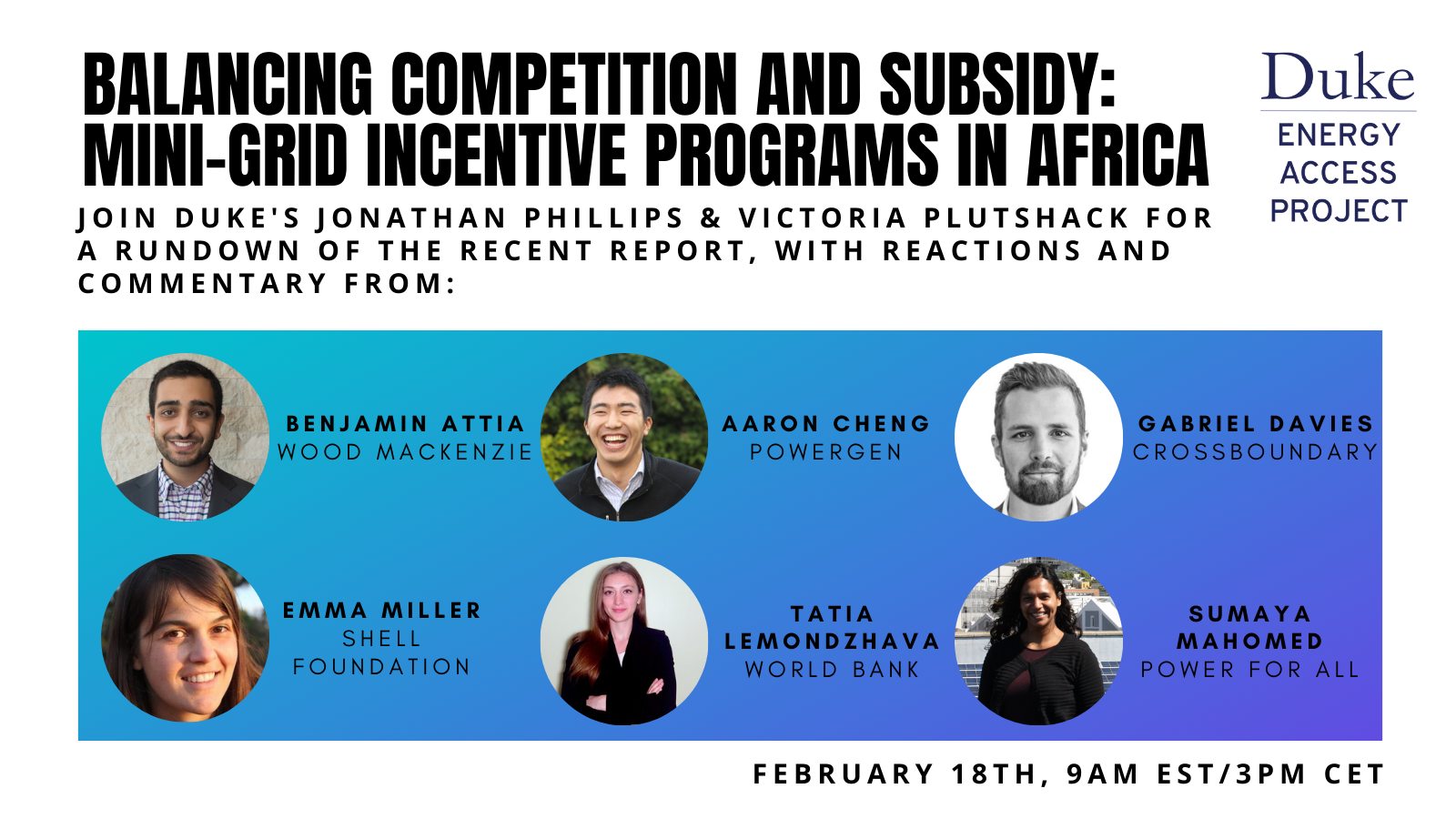
Listen now! Balancing Competition & Subsidy: Mini-Grid Incentives Programs in Africa Webinar
What can we learn from countries trying to scale mini-grid deployment? In this webinar, hear early lessons from Africa in the latest report from the Energy Access Project at Duke, “Balancing Competition and Subsidy: Mini-grid Incentive Programs in Africa.” EAP’s Jonathan Phillips and Victoria Plutshack led the discussion with a host of experts in the field.

Energy Monitor: 2021 will see more climate finance for locally led energy access
EAP’s Jonathan Phillips explains that hundreds of millions of people will not get electricity access by 2030 if we rely on purely commercial off-grid approaches alone.

New Blog! Lessons from the proliferating mini-grid incentive programs in Africa
As governments put in place incentives to scale up mini-grid deployment, our team has reviewed 20 mini-grid programs in sub-Saharan Africa, in order to pull out some initial lessons.

New Report! Business model innovations for utility and mini-grid integration: Insights from the Utilities 2.0 initiative in Uganda
As a wave of decentralised renewable energy (DRE) technologies and business models are changing the energy service delivery landscape, this new Energy Insight focuses on the opportunities for distribution utilities and mini-grid developers to collaborate.

What COVID-19 has cost the climate
Climate talks like the annual Conference of the Parties (COP) have led to many climate successes; informal conversations between international stakeholders at COP can become leverage for policy change at home, as seen in the case of Chile’s ambitious voluntary coal retirement scheme.
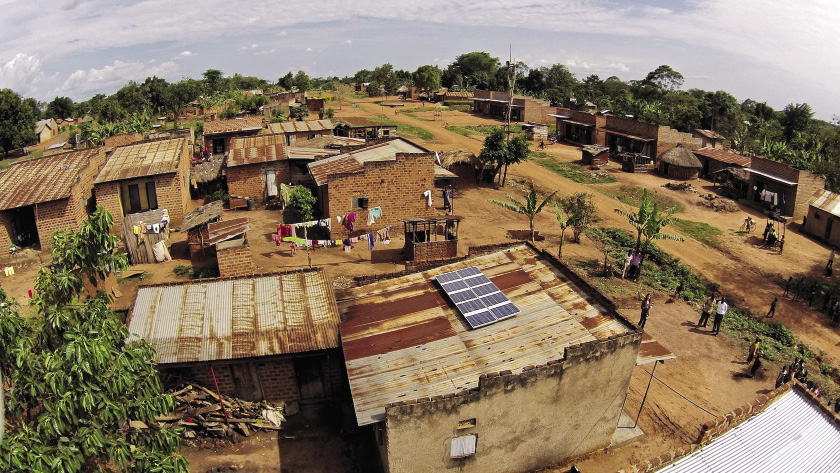
PV Magazine: Machine learning: ‘New electricity’ enabling access
EAP research on using satellite and drone imagery to automatically detect solar PV panels featured in PV Magazine.