

Jonathan Phillips


Director, James E. Rogers Energy Access Project
Contact: 919-681-7188, jonathan.phillips@duke.edu
Phillips is the Director of the James E. Rogers Energy Access Project at Duke University, with an appointment at the Nicholas Institute for Energy, Environment & Sustainability. His work focuses on policy, regulatory, and economic issues related to rural electrification, reliability, off-grid energy systems, and energy for productivity.
Phillips was the senior advisor to the president and CEO of the Overseas Private Investment Corporation (now the US Development Finance Corporation), helping scale-up the agency’s climate finance capabilities. He led the implementation of strategic initiatives, including the agency’s $3 billion Power Africa portfolio.
Before that, Phillips led private sector engagement and programming with Power Africa at USAID, helping ramp-up the $300 million presidential initiative into one of the largest public-private development partnerships in the world.
From 2007-2014, he advised members of the House and Senate and supported many notable legislative efforts, including serving as a lead author of the Waxman-Markey climate and energy bill that passed the House in 2009. He was also a senior policy advisor on the House Select Committee on Energy Independence and Global Warming as well as the House Natural Resources Committee.
Phillips was a business and economic development volunteer with the Peace Corps in Mongolia. He received a bachelor’s degree from the Milwaukee School of Engineering and a master’s degree in public policy from the Harvard Kennedy School.
Recent work by Phillips includes:
- Journal Article: Estimating Lost Dividends from Incomplete Energy Access Transitions
- Blog: Adaptation and resilience investment: How do we get the capital it needs
- Working Paper: Resilience Monetization and Credits Initiative: A Background Paper
- Blog: The Emergence of ‘Resilience Credits’: How a New Asset Class Can Unlock Investment in Climate Resilience — And Why Impact Measurement Will be Key to its Success
- Report (contribution): The State of Blended Finance 2023: Climate Edition
- Journal Article: Barriers to off-grid energy development: Evidence from a comparative survey of private sector energy service providers in Eastern Africa
- Report: Mobilizing new climate investment models
- Report: Inclusive low-carbon transitions for sustainable development in the global south
- Policy Brief: Making clean energy transitions more inclusive: Evidence, knowledge gaps and policy options in low-income economies
- Blog: Climate Finance Myth Busting
- Op-ed: JETPs and other ways to shift climate finance toward low-income countries
- Policy Brief: Can Time-of-Use Tariffs Increase the Financial Viability of Mini-Grids?
- Policy Brief: Climate Finance for Just Transitions
- Policy Brief: Barriers and Policy Solutions for Off-Grid Energy Development
- In the news: How to Transition to a Clean Energy Future
- Policy Brief: Improving Rural Livelihoods, Energy Access, and Resilience Where It’s Needed Most: The Case for Solar Mini-Grid Irrigation in Ethiopia
- Working Paper: Barriers to off-grid energy development: Evidence from a comparative survey of private sector energy service providers in East Africa
- Report: Catalysing Climate Finance for Low-Carbon Agriculture Enterprises
- Report: COVID-19 and Distributed Renewables: How the Crisis Has Affected the Sector and What It Means for People, the Planet, and the Future of Energy Access
- Blog: How finance, ag-tech and more can speed the energy transition – 4 experts explain
- Blog: Climate finance meets low-carbon agtech
- Blog: Net Zero may be coming. But America is a fossil fuel bank to the developing world today.
- Policy Brief: Modernizing Energy Access Finance, Part 2—Balancing Competition and Subsidy: Assessing Mini-Grid Incentive Programs in sub-Saharan Africa
- Blog: Lessons from the proliferating mini-grid incentive programs in Africa
- Report: Business model innovations for utility and mini-grid integration: Insights from the Utilities 2.0 initiative in Uganda
- Policy Brief: Lessons for Modernizing Energy Access Finance, Part 1: What the Electrification Experiences of Seven Countries Tell Us about the Future of Connection Costs, Subsidies, and Integrated Planning
- Blog: An off-grid energy future requires learning from the past
- Report: The Energy Access Dividend: Accelerating off-grid solutions and bolstering reliability can generate big gains in Honduras and Haiti
- Report: The Energy Access Dividend in Honduras and Haiti
- In the News: The Powerlessness of Nigeria’s Tech Startups
- Publication: New Data and Technologies are Transforming Energy Access – Public Policy Must Catch Up
- Policy Brief: Profits and Productivity: Stimulating Electricity Demand in Low-Income Settings
- Publication: Research Agenda on Electricity Access and Productive Use
- Publication: The True Cost of Solar Tariffs in East Africa
- Publication: Harnessing the Power of Data: Sustainable Energy Transitions Initiative Conference
- Publication: Can a Modernized U.S. Development Finance Institution Help Close the Energy Financing Gap?
- Essay: Seven Takeaways from the Energy Access Launch
- Op-ed: Opinion: Solar tariffs to affect world’s poorest
My Work

Incentivizing Grid Reliability in Low- and Middle-Income Countries
On October 14, 2025, an in-person roundtable discussion in Washington D.C. unpacked the power reliability challenge in low- and middle-income countries and pressure-tested ideas from the newly released working paper Incentivizing Reliability: A Framework for Performance-Linked Electricity Improvements. Click here to learn more about our work in this area.

Energy Transitions & Investment in Emerging Markets: Navigating Shifting Undercurrents – Summit Insights
Energy Transitions & Investment in Emerging Markets: Navigating Shifting Undercurrents Summit InsightsApril 2025The Energy Transitions and Investment in Emerging Markets: Navigating Shifting Undercurrents summit was convened on April 8, 2025, during a moment of...

Resilience Monetization and Credits Initiative
The Resilience Monetization and Credit Initiative (RMCI) aims to close the finance gap for those urgently needing climate adaptation finance by developing innovative methods to measure and monetize adaptation and resilience benefits. RCMI seeks to align public and...
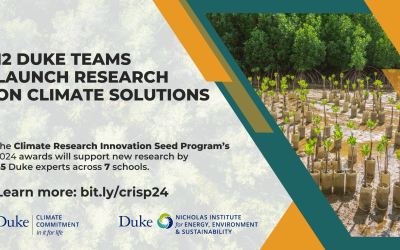
CRISP 2024 Research Award
EAP received a Duke Climate Research Innovation Seed Program (CRISP) award to research “Monetizing Resilience to Mobilize Climate Capital: Understanding the Value of Climate-Smart Agriculture in East Africa”.

Phillips Appointed as Visiting Professor to Duke Kunshan University for Fall Semester
Jonathan Phillips, director of the James E. Rogers Energy Access Project at Duke University, will be a visiting associate professor at Duke Kunshan University (DKU) in China during fall 2023. Jonathan will work with DKU’s International Master of Environmental Policy program, furthering research on low-carbon development and investment.

Barriers and Policy Solutions for Off-Grid Energy Development
The falling costs of solar technology and development of new and more cost-effective battery technologies have made off-grid solutions the preferred least cost technology for electrification in many rural settings. Yet, the sector faces numerous challenges that...